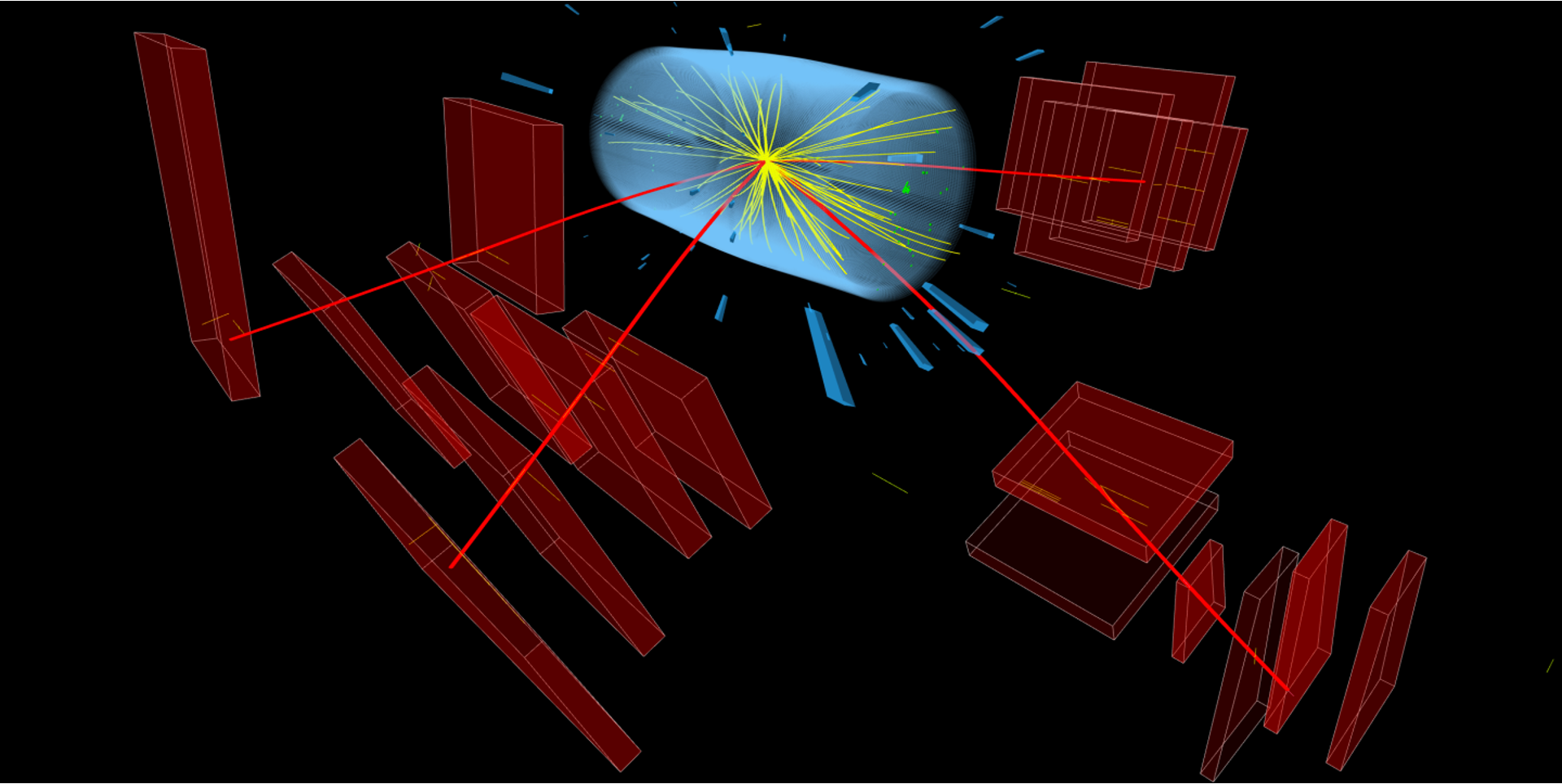


Modern particle physics seeks to answer some of the most profound questions in science: What are the truly fundamental constituents of matter? What is the origin of mass, and are there undiscovered particles that make up dark matter? Are there new symmetries or hidden dimensions in nature, and why does the Universe contain more matter than antimatter?
To address these questions, physicists use powerful accelerators such as the Large Hadron Collider, where particles are collided at extremely high energies, recreating in miniature the conditions of the early Universe just after the Big Bang. At the University of Florida, experimental particle physics and astrophysics join forces in the Institute for High Energy Physics and Astrophysics and particle theorists are members of the Institute for Fundamental Theory.
Korytov Group
The Korytov Group focuses on Higgs boson properties and searches for beyond-standard-model physics at CMS. Current research includes measurements of Higgs boson properties in the H→4l channel and searches for charged lepton flavor violating decays t→3μ. Korytov led the design and construction of the Cathode Strip Chambers for the Endcap Muon System (1994-2005) and served as Muon Upgrade Coordinator (2018-2022). He founded and led the CMS Higgs Combination Group at the time of the Higgs boson discovery and has played critical roles in H→4l analyses including the observation of the Higgs boson in 2012 and subsequent measurements of mass, spin-parity quantum numbers, and production cross sections.
Senior Research Scientist: Jian Wang
Postdoctoral Researcher: Caterina Aruta
Graduate Student: Neha Rawal
Konigsberg Group
The Konigsberg Group focuses on Higgs boson physics and trigger systems at CMS. Current research centers on searches for di-Higgs and multi-Higgs production with H→bb final states. Konigsberg serves as coordinator of the CMS L1 Muon Trigger upgrade project and Level-3 manager for the USCMS Phase-2 Muon Trigger, coordinating the UF group’s L1 trigger operations tasks and upgrade projects including electronics, firmware, and software developments. He previously served as CDF co-spokesperson (2006-2010), convener of the CMS H→bb Group (2013-2014), and led the simulation effort for the Associative Memory approach in the Track Trigger project.
Postdoctoral Researcher: Marina Kolosova
Graduate Students: Haichen Fan, Evan Koenig
Chang Group
The Chang Group focuses on electroweak multi-boson production and Higgs physics at the CMS experiment. Current research includes measurements and searches for VVV, VH, and VVH production using heterogeneous computing. Chang developed the Line Segment Tracking (LST) algorithm for HL-LHC and currently serves as L3 Advanced Algorithm Coordinator for HL-LHC R&D within USCMS S&C Operations program and directs the UF CMS Tier-2 center. The group leads R&D initiatives deploying LST algorithm-as-a-Service using GPU computing resources for CMS. Recent achievements include the first observation of VVV production, first observation of H→WW, and first evidence for VBF H→WW.
Postdoctoral Researcher: Kelci Mohrman
Graduate Students: Matthew Dittrich, Alexandra Aponte Utani
Takahashi Group
The Takahashi Group focuses on tau-lepton physics, B-physics, and searches for new physics at CMS. Current research includes Lepton Flavor Universality tests using B mesons with an innovative low-momentum tau identification algorithm that reconstructs tau leptons with momenta as low as a few GeV. Takahashi developed the standard tau reconstruction algorithms used by CMS and is developing a Phase-2 Level-1 Tau Trigger. He currently serves as co-convener of the Jets+X sub-group of the Exotica Physics Analysis Group. Recent achievements include key contributions to the observation of the Higgs boson decaying to tau leptons and searches for leptoquarks preferentially coupled to tau leptons. Takahashi was awarded the CMS Young Researcher Prize in 2022.
Postdoctoral Researcher: Chiara Basile
Graduate Student: Pierce Affleck
Yelton Group
Prof. Yelton is part of Belle II, a multi-national collaboration of around 1000 scientists from 100 institutes in 26 countries, studying the particles produced by high-energy electron-positron annihilations. His own research centers on the production and decay of charmed particles, and for roughly four decades has focused on charmed baryons — particles like protons and neutrons, but containing a charm quark in place of the generic up and down quarks that make up ordinary matter. The aim is to find and classify all the charmed baryons, including excited states in which the three constituent quarks fit together in different ways, and to measure their properties. Because all charmed baryons decay quickly and their decays usually involve strange baryons, charmed baryon decays also provide one of the best available methods for studying strange baryons.
Learn More About Yelton