

Condensed Matter Physics
Condensed matter physicists ask what happens when you put a huge number of atoms or electrons together. Sometimes it is a handful of molecules, sometimes a whole crystal, and sometimes a living cell. Our groups make new materials and measure them, or work out the theory of why they behave the way they do. A lot of today’s electronics started this way. Faculty here work with chemists, materials scientists and biologists through the Center for Condensed Matter Sciences, and run experiments at MAIC and NRF on campus, at the National High Magnetic Field Laboratory, and at national labs like Oak Ridge, Argonne, Los Alamos and Brookhaven.
Condensed Matter Theory
Condensed matter theorists at UF develop analytical, numerical, and machine-learning approaches to quantum materials, from unconventional superconductivity and strongly correlated electrons to disorder, transport, and topological phases of matter.

Hershfield Group
Quantum Transport in Nanostructures

Hirschfeld Group
Many-Body Quantum Materials

Ingersent Group
Strongly Correlated Electron Theory

Jia Group
Computational Quantum Materials

Maslov Group
Theory of Electronic Transport

Muttalib Group
Disorder, Frustration, and Transport

Pan Group
Quantum Dynamics and AI for Physics

Stanton Group
Ultrafast Semiconductor Theory

Wang Group
Correlated Electron Theory

Yu Group
Topological Quantum Materials Theory
Theory Faculty


Hershfield Group
The Hershfield group studies electrical transport in nanostructures where both quantum interference and interactions are important. Recently they have been simulating the transport in the complex interconnected donor and acceptor networks of bulk organic heterojunction solar cells (pictured). The group also has an ongoing project related to quantum computing that studies the properties of a quantum many-body Hamiltonian that can be used to factor products of prime numbers.
Learn MoreHirschfeld Group
The Hirschfeld group studies problems of modern many-body theory associated with quantum materials. These are condensed matter systems that cannot be described by the conventional Bloch picture of a single electron moving in a periodic potential. They exhibit remarkable collective phenomena and novel ordered phases, and are expected to be relevant to the next generation of electronic devices. One particular focus is on “unconventional” superconductors, where electron pairing is driven by repulsive Coulomb interactions. Recently, a second focus has been opened on discovery of “extraordinary conventional” superconductors including developing machine learning materials discovery models to calculate Eliashberg functions and Tc.
Graduate Students: Siddhant Panda, Pawan Prakash, Ge Wang
Research Assistant Scientist: Benjamin Geisler
Ingersent Group
The Ingersent group’s research addresses aspects of strongly correlated electron systems: materials in which the motion of each charge carrier is greatly influenced by that of the other carriers. Current work focuses on “non-Fermi-liquid” physics (metallic behavior very different from that of conventional metals such as copper) arising near the absolute zero of temperature from (i) a bulk phase transition between different quantum-mechanical ground states of a compound or alloy; or (ii) a transition between ground states of a magnetic nanostructure such as a quantum-dot device. The essential element in both cases is competition between different spatially extended degrees of freedom (e.g., conduction electrons, magnetic interactions, electromagnetic fluctuations) for control over the behavior of local spin degrees of freedom.
Image: J. H. Pixley, S. Kirchner, K. Ingersent, and Q. Si, “Quantum criticality in the pseudogap Bose-Fermi Anderson and Kondo models,” Phys. Rev. B 88, 245111 (2013).
Jia Group
The Jia group works at the intersection of condensed matter physics and advanced computational modeling, with a specialized emphasis on developing AI-driven algorithms to accelerate the discovery and understanding of quantum materials. The group uses cutting-edge numerical simulations to understand the microscopic properties of a variety of quantum materials, including high-temperature superconductors, altermagnetism, and frustrated magnets. By integrating machine learning with many-body numerical techniques and X-ray spectroscopy theory, the group works to bridge the gap between theoretical predictions and experimental observations in complex correlated systems.
Graduate Students: Regan Bhatta, Adrian Bahri, Yu Zhang, Anguie Xiomara Gonzalez Duque, Nhat Huy Tran
Assistant Scientist: Shuyi Li
Maslov Group
Dmitrii Maslov’s group does theory on how electrons move through real materials, where disorder and interactions both matter. One current project uses Feynman diagrams to explain unusual features in the resistance that show up near ordinary, classical phase transitions. Another proposes ways to flip and move spins very quickly in graphene stacked on transition-metal dichalcogenides, which give the graphene extra spin-orbit coupling. What ties it together is how disorder, fluctuations and spin play out in low-dimensional quantum materials.
Students: Joshua Covey, Tatia Kiliptari
Muttalib Group
The Muttalib group investigates the quantum physics of disorder, non-equilibrium phenomena, and frustration in mesoscopic and nanoscale systems—systems where traditional macroscopic descriptions break down, because the distributions of observables are often so broad that the mean or variance fails to provide any meaningful description.
A central focus is disordered mesoscopic systems such as quantum wires and other nanostructures, where a long-term interest has been the novel phenomena associated with these broad distributions in electronic transport and the theoretical tools needed to describe their surprising universality. One powerful tool is random matrix theory, including recent work on the Muttalib-Borodin ensemble and its generalizations for quantum transport and metal-insulator transitions.
A second thrust explores thermally inhomogeneous systems and energy conversion at the nanoscale, where non-linear effects in nanowires allow for devices with high efficiency and large power output. This work has produced an exact mapping of surface disorder onto a smooth wire with additional phonon interactions, and a generalization of non-equilibrium quantum field theory to thermally inhomogeneous systems that predicts a breakdown of the Wiedemann-Franz law.
The group also pursues exact solutions of toy models that provide insight into more complicated realistic systems, including a quantitative description of frustration in disordered systems; recent work focuses on inelastic neutron scattering from geometrically frustrated Ising antiferromagnets and field-induced transitions in two-dimensional ferromagnets.
Image: K.A. Alam and K.A. Muttalib, “Conductance distribution across the Anderson transition in a random matrix model”, Phys. Rev. B. 106, 184203 (2022)
PhD Student: Yuan Gao
Pan Group
Haining Pan is a theorist whose group sits somewhere between quantum information, condensed matter and machine learning. A lot of the current work is on quantum circuits, where gates, measurements, feedback and noise all get mixed together and you ask what kind of state comes out. In a recent paper done with IBM Quantum, they ran adaptive circuits on a real superconducting chip and got chaotic dynamics to settle into order. Pan also works on Majorana qubits for topological quantum computing and on twisted moiré materials. On the AI side, he helped build CMT-Benchmark with Google, a set of problems that checks whether AI models can actually do condensed matter theory.
Graduate Student: Raju Sharma Khatiwada
Undergraduate Researcher: Caleb T. Hebert
Stanton Group
Chris Stanton is a theorist who works on semiconductors and their nanostructures, like quantum wells, superlattices, quantum dots and 2D materials. A lot of his group’s work asks what a sample does in the few picoseconds after it gets hit with a very short laser pulse. The electrons and holes heat up and cool down, the lattice can start ringing, and some of that shows up as terahertz light. Stanton’s group worked out the first microscopic theory of how these coherent phonons get started. They work closely with experimental groups, right now at Virginia Tech and at NIMS in Japan. Lately they have also been looking at cesium lead bromide perovskite nanocrystals, which are very stable and give off a lot of light.
Image: K. Ishioka et al., “Robust coherent phonon mode at GaP/Si(001) heterointerface,” J. Phys.: Condens. Matter 38, 175001 (2026).
Graduate Student: Parisa Alimohamadi
Wang Group
The Wang group works on strongly correlated systems, including non-Fermi liquids, unconventional superconductivity, and topological phases of matter. The group is also interested in general aspects of quantum field theory and its applications to condensed matter systems.
Graduate Students: Ethan Huecker, Connor Naughton
Postdoc: Saavanth Velury
Yu Group
The Yu group focuses on topological quantum materials and strongly correlated systems, including moiré superlattices, topological quantum field theory, and superconductivity. The group brings a range of computational approaches to these problems, spanning density functional theory, machine learning, and quantum algorithms.
Image: “Moiré materials based on M-point twisting,” Nature (2025).
Graduate Students: Ethan Angerhofer, Thomas Caligiure, Lexu (Gavin) Zhao, Mengke Zhang, Ashwini Malviya
Condensed Matter Experiment
Experimental groups grow, fabricate, and measure quantum materials and devices, often at ultralow temperatures and in high magnetic fields, including through the National High Magnetic Field Laboratory’s High B/T Facility at UF.

Biswas Lab
Oxide Thin Films and Interfaces

Chen Lab
Spectroscopy of Quantum Materials and Devices

Gazizulin Group
Sub-millikelvin Cryogenics and Quantum Systems

Hamlin Lab
Materials Under Extreme Pressure

Laroche Lab
Coupled Nanoscale Quantum Devices

S. Lee Group
Correlated Matter in High Fields

Y. Lee Group
Quantum Fluids Near Absolute Zero
Meisel Group
Quantum Matter in Extreme Conditions

Pedrozo-Peñafiel Group
Cavity QED and Quantum Sensing

Stewart Lab
AI-Driven Superconductor Design

Sullivan Group
Quantum Magnets at Low Temperatures

Takano Group
Quantum Magnetism at Low Temperature

Zhang Lab
Optical Spectroscopy of 2D Materials
Experimental Faculty


Biswas Lab
Complex oxides such as perovskite manganese oxides (manganites) and high critical temperature (Tc) cuprate superconductors are among the most fascinating systems in condensed matter physics, due to the challenges they pose to our understanding of fundamental phenomena and their potential for applications. The Biswas group’s research program includes both sample preparation and measurement: students work in teams on pulsed laser thin film deposition systems, superconducting magnets, nanofabrication facilities, and scanning probe microscopes, studying materials at temperatures down to 1.5 K and magnetic fields up to 33 T. The overarching focus is the ability to control magnetism in materials using electric fields, the so-called magnetoelectric effect. The group is now moving toward two-dimensional and topological materials, focusing on the phenomena that emerge at interfaces between different materials.
Learn MoreChen Lab
The Chen Lab studies quantum materials, with a focus on two-dimensional materials and devices whose properties can be engineered through stacking and electrostatic gating. We are particularly interested in superconductivity, topological phases, and light–matter interactions in these systems. We fabricate our own devices and develop on-chip terahertz and microwave spectroscopy techniques to probe them. We also work at synchrotron beamlines, with the goal of directly measuring the electronic structure of these devices using angle-resolved photoemission spectroscopy (ARPES).
Learn MoreGazizulin Group
The Gazizulin Group conducts experimental low-temperature physics research focused on ultralow-temperature cryogenics and quantum systems in high magnetic fields. The group develops nuclear demagnetization refrigeration and sub-millikelvin platforms, along with compact thermometry and instrumentation for extreme environments at the MagLab. Research includes studies of low-dimensional and strongly correlated systems, such as Coulomb drag and non-Fermi-liquid behavior in quasi-one-dimensional conductors, as well as computational work on spin-chain materials with strong magnetocaloric effects near quantum critical points.
Hamlin Lab
James Hamlin’s lab makes new materials and then squeezes them. They grow their own crystals, check what they have at normal pressure, and then put them in a diamond anvil cell, sometimes in a high magnetic field too. The pressures go from a few kilobars, about what you’d feel at the bottom of the ocean, up to megabars, which is getting close to the center of the Earth. Mostly they want to know when unusual or high-temperature superconductivity appears, especially near a quantum phase transition, but new materials tend to throw up other surprises as well.
Graduate Student: Zhongwei Li
Undergraduate Researchers: Aahan Dwivedi, Juan Esquivel
Laroche Lab
Research activities in the Laroche Lab revolve around the design and fabrication of quantum devices coupled at the nanoscale and the study of the interactions that arise between such closely packed systems when cooled to cryogenic temperatures. Current efforts include measuring electronic drag effects between pairs of one-dimensional systems coupled at the nanoscale and exploring the onset of exciton condensation in SiGe-based double quantum well heterostructures. Both systems hold promise for the engineering of novel qubit platforms.
PhD Candidates: Suyang Cai, Davis Chen, Mingyang Zheng
Undergraduate Researchers: Nathan Rao, Glen Gillia, Ruben Anderson
S. Lee Group
As part of the National High Magnetic Field Laboratory, the Lee group places strong emphasis on supporting a broad user community while advancing in-house research enabled by state-of-the-art low-temperature measurement capabilities. The group’s work is grounded in extensive expertise with cryogenic instrumentation, high-field measurement platforms, and advanced transport and spectroscopic techniques.
Building on this infrastructure, the group focuses on emergent phenomena in strongly correlated systems, particularly unconventional superconductivity and quantum spin liquids: investigating pairing mechanisms and gap structures in topological and heavy-fermion superconductors near quantum critical points, and developing precision low-temperature probes to identify signatures of fractionalization in geometrically frustrated materials. The research spans heavy-fermion compounds, transition-metal dichalcogenides, high-temperature superconductors, and candidate quantum spin liquid materials, under extreme conditions of high magnetic field, high pressure, and ultra-low temperature.
Y. Lee Group
Yoonseok Lee’s lab studies helium at temperatures close to absolute zero. The group has measured the sound and magnetic properties of liquid and solid helium-3, including superfluid helium-3 inside aerogel, and also looks at low-dimensional conductors at low temperature. More recently they have used tiny micro-machined (MEMS) oscillators immersed in superfluid helium to study how quantized vortices get pinned and move, and have worked on the idea of using superfluid helium to detect light dark matter.
Image: T. Nakagawa, M. Tsubota, K. Gunther, and Y. Lee, “Dynamics of pinned quantized vortices in superfluid 4He in a microelectromechanical oscillator,” Phys. Rev. B 108, 144110 (2023).
Meisel Group
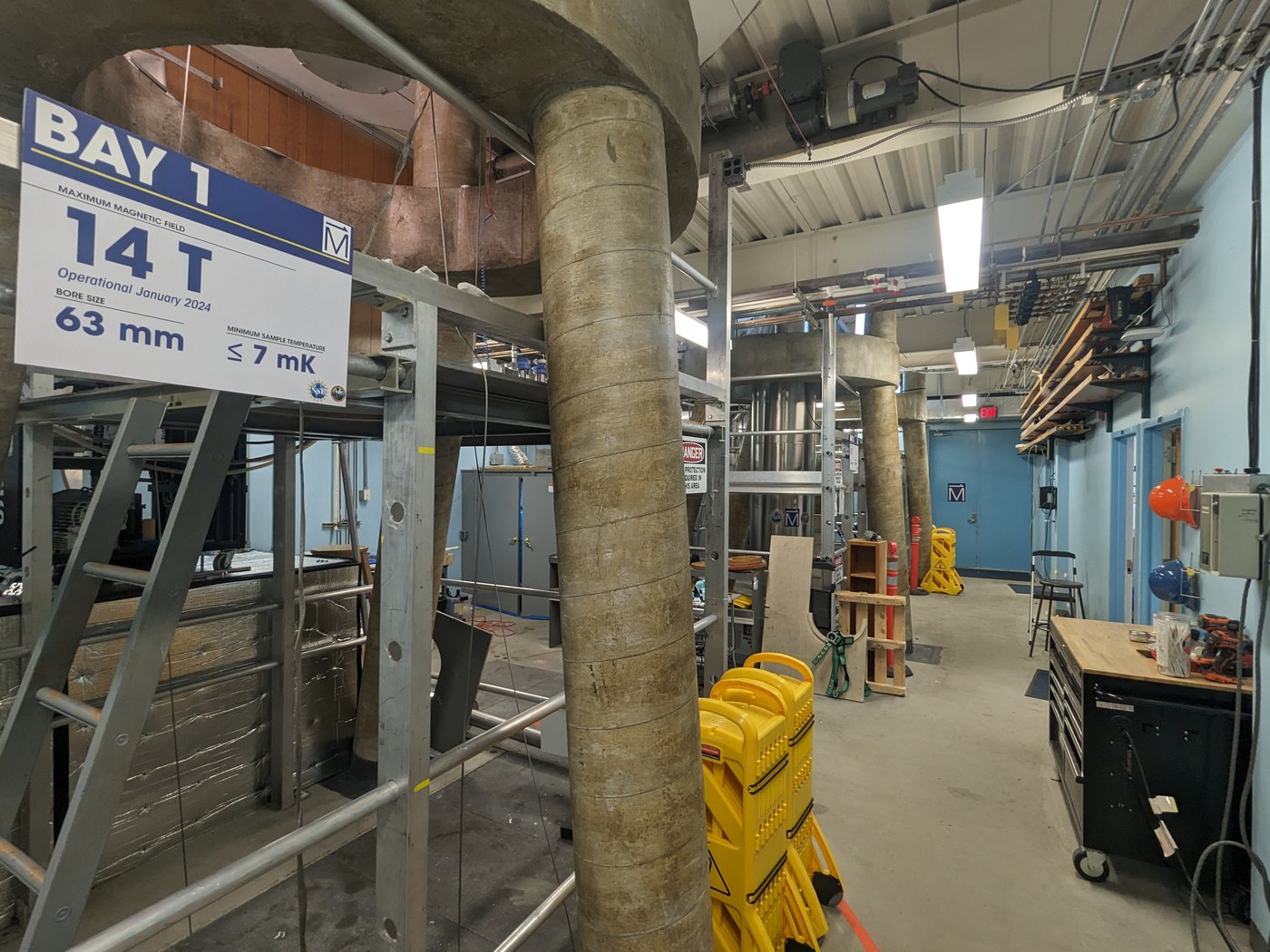
Mark Meisel’s group runs experiments on quantum materials at very low temperatures and in very high magnetic fields. They look at superconductors, strongly correlated electron systems and other quantum phases, mostly through transport and magnetic measurements. Much of the work happens at the MagLab High B/T Facility and the UF BxT Facility, where samples can be pushed to extreme temperature, field and pressure, which is often where new electronic states turn up.


Pedrozo-Peñafiel Group
Edwin Pedrozo-Peñafiel’s lab puts ultracold atoms, and eventually molecules, inside an optical cavity, basically two very good mirrors facing each other. Light bouncing back and forth talks to the whole cloud at once, so you can read out the atoms without wrecking their quantum state. The same trick lets you entangle the atoms, which makes measurements more precise than the usual standard quantum limit. Before coming to UF he worked on an entangled optical atomic clock at MIT. The big goal now is to bring these cavity methods over to ultracold molecules and use them for precision measurements and tests of fundamental symmetries.
Image: E. Pedrozo-Peñafiel et al., “Entanglement on an optical atomic-clock transition,” Nature 588, 414 (2020).
Stewart Lab
The Stewart Lab focuses on AI-driven design of superconducting materials for high-field magnet applications, supported by NSF DMREF. The group also works on discovering new superhard materials with hardness above 30 GPa for use in turbine blades, armor, and other high-hardness applications. Current efforts include computational and experimental collaboration on materials discovery, including work supported through proposals to the Army Research Office in collaboration with Profs. G. Subhash and R. Hennig.
Image: J. Lim et al., “Creating superconductivity in WB2 through pressure-induced metastable planar defects,” Nature Communications 13, 7901 (2022).
Postdoc / Research Scientist: Dr. Jungsoo Kim
Sullivan Group
The Sullivan group currently focuses on using unique high-sensitivity techniques to measure the radio frequency susceptibility of quantum magnets at low temperatures. Recent results include the direct detection of electric field induced changes in the magnetic susceptibility of frustrated Fe-3 trimers considered as potential quantum qubits. The group also uses magnetic resonance techniques to study the dynamics of quantum fluids and solids at very low temperatures, notably the motion of 3He impurities in solid 4He, and the properties of H2 constrained to the interior cages of molecular organic frameworks. The Sullivan laboratory also operates a low temperature axion haloscope using a superconducting resonant coil and a 3He refrigerator.
Postdocs (CME/M2QM): J. Adams, M. Lewkowitz
Undergraduate Researchers (Astrophysics/Axion): M. Solano, Nguyen Trinh
Takano Group
Yasu Takano’s group works on quantum magnetism, nuclear magnetism, and quantum fluids and solids, usually at very low temperatures and in high magnetic fields at the National High Magnetic Field Laboratory. Much of the recent work measures heat capacity and magnetization in spin systems that are close to one-dimensional or sit on a triangular lattice, where a strong field can push the spins through a series of quantum phase transitions. One recent study found random singlets forming in a nanocrystalline spin chain. He is also part of the Microkelvin Laboratory on campus.
Image: Y. Guo et al., “Formation of random singlets in the nanocrystalline quasi-one-dimensional spin-1/2 antiferromagnet Sr21Bi8Cu2(CO3)2O41,” arXiv:2308.16338 (2023).
Zhang Lab
The Zhang Lab investigates novel 2D material systems using optical spectroscopy, optoelectronics, and optomechanics. The lab focuses on exploring the electronic, optical, and spin properties of these systems using both steady-state and ultrafast optical techniques, typically at cryogenic temperatures and under applied magnetic fields.
PhD Students: Alejandro Busto, Kamal Harrison, Liza Godziashvili
Postdocs: Pavel Valencia Acuna, Jia-Yi Ji

Assembling a cryostat sample probe

Aligning optics on the laser table

A laser experiment in the darkened optics lab